

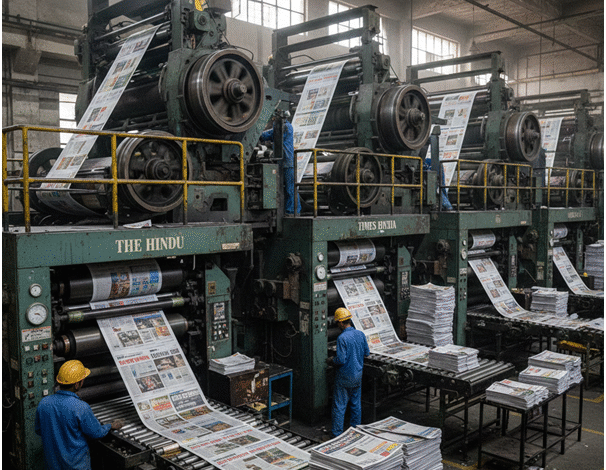
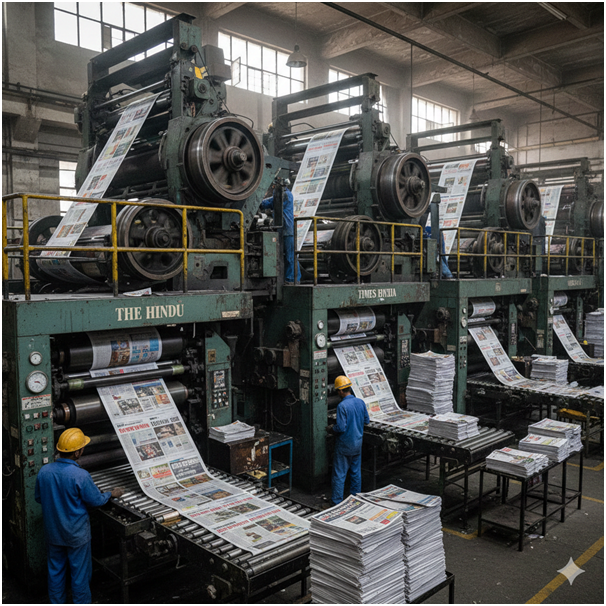
it is evolving into a more focused, regionally strong and credibility-driven medium that will coexist with digital rather than disappear.
Current state of print in India
Print newspapers and magazines in India are projected to generate about US$3 billion in revenue in 2025, making the country one of the world’s largest print markets.
Audit Bureau of Circulations data for the January–June 2025 period shows daily newspaper circulation rising 2.77% to around 29.7 million copies, indicating that readership remains resilient.
Print’s advertising share in India, while declining over time, is still high by global standards at about 20% of total ad spend in 2023, compared with roughly 4% globally.
In value terms, print ad revenue grew from about ₹16,595 crore in 2021 to ₹19,250 crore in 2023, and crossed roughly ₹20,000 crore in 2024, surpassing pre‑Covid levels.
Why print still matters
India is an outlier where print advertising revenues are expected to grow around 3% even as global print ad revenue declines.
Drivers include high trust in newspapers, strong regional language readership, and growing ad demand from government, retail, education, real estate and FMCG sectors.
Print newspapers reach roughly half of Indian consumers daily, with average print consumption stabilising instead of collapsing, which reinforces their role as a mass yet credible medium.
Top Hindi, English and regional dailies together reach tens of millions of readers, with titles like Dainik Bhaskar, Malayalam Manorama and The Times of India each circulating well over a million copies per day.
Key trends shaping the future
Print’s share of ad spend has fallen from about 35% in 2016 to 20% in 2023 and is forecast to dip further to around 16–18% by 2025 as digital accelerates.
At the same time, absolute ad spends on print are still rising modestly, meaning brands are investing more in print but allocating a smaller percentage of their budgets to it.
Cost dynamics are improving for publishers as newsprint prices have eased from post‑Covid peaks of over ₹80,000 per metric tonne to around ₹50,000, supporting margins and sustainability.
Elections, government campaigns and big‑ticket launches in categories such as automotive and real estate continue to trigger spikes in print ad demand in specific years.
Print + digital convergence
Most large newspaper groups now operate as integrated news brands, combining print with websites, apps, e‑papers, and social channels to monetise both audiences and advertisers.
Advertisers increasingly use print for front‑page impact and credibility, while using digital for frequency, performance, and retargeting, creating “print plus” campaigns rather than print‑only plans.
Sectors heavily reliant on trust—government, education, healthcare, BFSI—still allocate a significant share of their media budgets to print, while using digital mainly as a complement.
Regional and vernacular markets see particularly strong “print plus local digital” strategies, where newspapers anchor brand presence in specific states or cities.
What the future looks like
Forecasts suggest Indian print advertising will remain a multi-billion‑dollar market through the late 2020s, even as growth slows and digital takes the majority share of ad budgets.
Print is likely to become more premium, urban‑plus‑regional, and event-driven, focusing on high-impact formats, supplements, and branded content rather than commodity classifieds.
For marketers in India, the future is not “print versus digital” but “print where it builds trust, digital where it drives action,” with data-driven planning determining the optimal mix.
For publishers, long-term survival will depend on diversifying into digital subscriptions, events, and niche magazines while using the print brand as the credibility engine.


